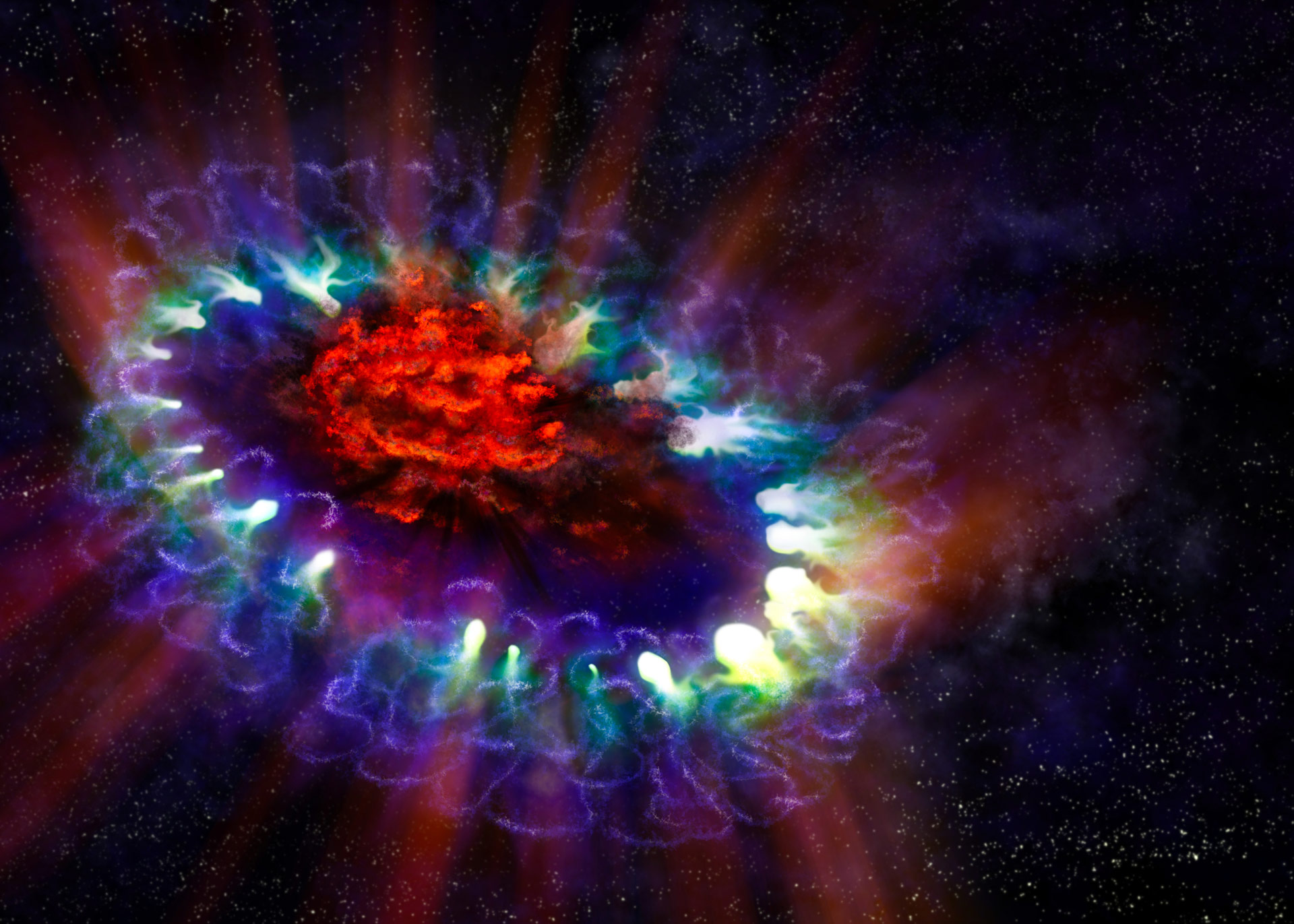
Forget fireworks, these things produce more colors than the colors found in a one hundred and twenty crayons in a Crayola crayon box. These supernovas can come in many shapes and sizes but when a cool explosion happens, it is a circular shape.
So what exactly is a supernova and how is it formed? A supernova is a stellar explosion that briefly outshines an entire galaxy, radiating as much energy as the Sun or any ordinary star is expected to emit over its entire life span, before fading from view over several weeks or months. Because our knowledge of space is so limited, scientists and physicists don't exactly know how supernovas are formed, however, a theory called the "Supernova Nuleosynthesis" theory is currently being used to broaden our understanding.
This theory, proposed by Fred Hoyle in nineteen fifty-four, states that with the fusion of lighter elements, such as hydrogen, helium and carbon, with the fusion of heavier elements such as titanium, iron and chromium, and the burning of oxygen and silicone, can create these beautiful explosions.
This theory also highlights a couple of things:
1) Every time an explosion occurs, we can observe all of the elements present. For example, when sulfur burns, it produces a blue color. Hydrogen produces an orange color when burning and mercury, depending on its chemical formula, will burn black for HgO and red for HgO 2+. By knowing the colors of each element present, we can accurately determine the amount of each element present in that certain area of the universe.

2) By following this theory, enough type of each metal and gas needs to be present in order to create planets such as Earth and Mars. This process can take a couple million to over a billion years to make happen in the fact that massive objects in space are formed from the deaths of generations of stars which then collect a decently sizable cloud to create an even bigger stars, which then forms into a "rock." This process continues to repeat itself endlessly.
So what do supernovas have to do with the news today? Astronauts, scientists and physicists are always on the lookout for supernovas, but they cannot accurately predict the timing and place of a supernova, thus, most of the time, they miss it. This past week, scientists and astronomers from NASA were able to pinpoint a supernova occurrence, due to the positions of the two stars, and are patiently waiting to record every single detail and they will be one step closer to solving the origins of the universe.

No comments:
Post a Comment