In light of THON occurring at Penn State from February twentieth to the twenty-second, I decided to search up stories that would benefit families medically. For a while, I couldn't find this particular type of story until today. Researchers may have found the solution to why older mothers have a higher risk of giving birth to children with birth defects.
Older mothers are prevalent in our society, and will continue to dramatically increase as time goes on. Women are nowadays encouraged to focus on their careers first before starting a family. The career I want to pursue, for example, requires me to dedicate at least a minimum of tens years after college to work on getting the degrees I need in order to be qualified for this job. With this alone, I would be at least thirty-two years old. In the news we always hear of either very young women giving birth or older women giving birth but how old exactly is too old?
Most women give birth at around their mid-twenties to their early thirties because this is considered the "healthy age" to give birth to children, but what if a mother wants children when she gets older? Why does she have to worry about other factors when involving the birth of her child as opposed to young mothers? There has to be something related to age to have this phenomena occur and researchers from the Albert Einstein College of Medicine of Yeshiva University may have found the answer.
The group of families who participated in this research was families who went through genetic counseling through 23andMe. The disease in particular that was the pinpoint of the study was Down syndrome. Down syndrome is a common disorder when a person has an extra number twenty-one chromosome. In turn this individual may face many physical disabilities compared to a person with a regular set of 46 chromosomes.
With the data conducted it was seen that as maternal age increases, regulation of chromosomes becomes weaker, thus older mothers tend to give birth to children with genetic defects. With this research in the works, a greater understanding is achieved and scientists will be able to work on medications to help older mothers have a higher chance to giving birth to a healthy child. If it can work with Down syndrome, maybe other diseases such as pediatric cancer may be detectable in its early stages for many children.
Thursday, February 19, 2015

Thursday, February 12, 2015
Supernova
In my opinion, one of the most beautiful things I have ever seen in my life is a supernova.

Forget fireworks, these things produce more colors than the colors found in a one hundred and twenty crayons in a Crayola crayon box. These supernovas can come in many shapes and sizes but when a cool explosion happens, it is a circular shape.
So what exactly is a supernova and how is it formed? A supernova is a stellar explosion that briefly outshines an entire galaxy, radiating as much energy as the Sun or any ordinary star is expected to emit over its entire life span, before fading from view over several weeks or months. Because our knowledge of space is so limited, scientists and physicists don't exactly know how supernovas are formed, however, a theory called the "Supernova Nuleosynthesis" theory is currently being used to broaden our understanding.
This theory, proposed by Fred Hoyle in nineteen fifty-four, states that with the fusion of lighter elements, such as hydrogen, helium and carbon, with the fusion of heavier elements such as titanium, iron and chromium, and the burning of oxygen and silicone, can create these beautiful explosions.
This theory also highlights a couple of things:
1) Every time an explosion occurs, we can observe all of the elements present. For example, when sulfur burns, it produces a blue color. Hydrogen produces an orange color when burning and mercury, depending on its chemical formula, will burn black for HgO and red for HgO 2+. By knowing the colors of each element present, we can accurately determine the amount of each element present in that certain area of the universe.

2) By following this theory, enough type of each metal and gas needs to be present in order to create planets such as Earth and Mars. This process can take a couple million to over a billion years to make happen in the fact that massive objects in space are formed from the deaths of generations of stars which then collect a decently sizable cloud to create an even bigger stars, which then forms into a "rock." This process continues to repeat itself endlessly.
So what do supernovas have to do with the news today? Astronauts, scientists and physicists are always on the lookout for supernovas, but they cannot accurately predict the timing and place of a supernova, thus, most of the time, they miss it. This past week, scientists and astronomers from NASA were able to pinpoint a supernova occurrence, due to the positions of the two stars, and are patiently waiting to record every single detail and they will be one step closer to solving the origins of the universe.
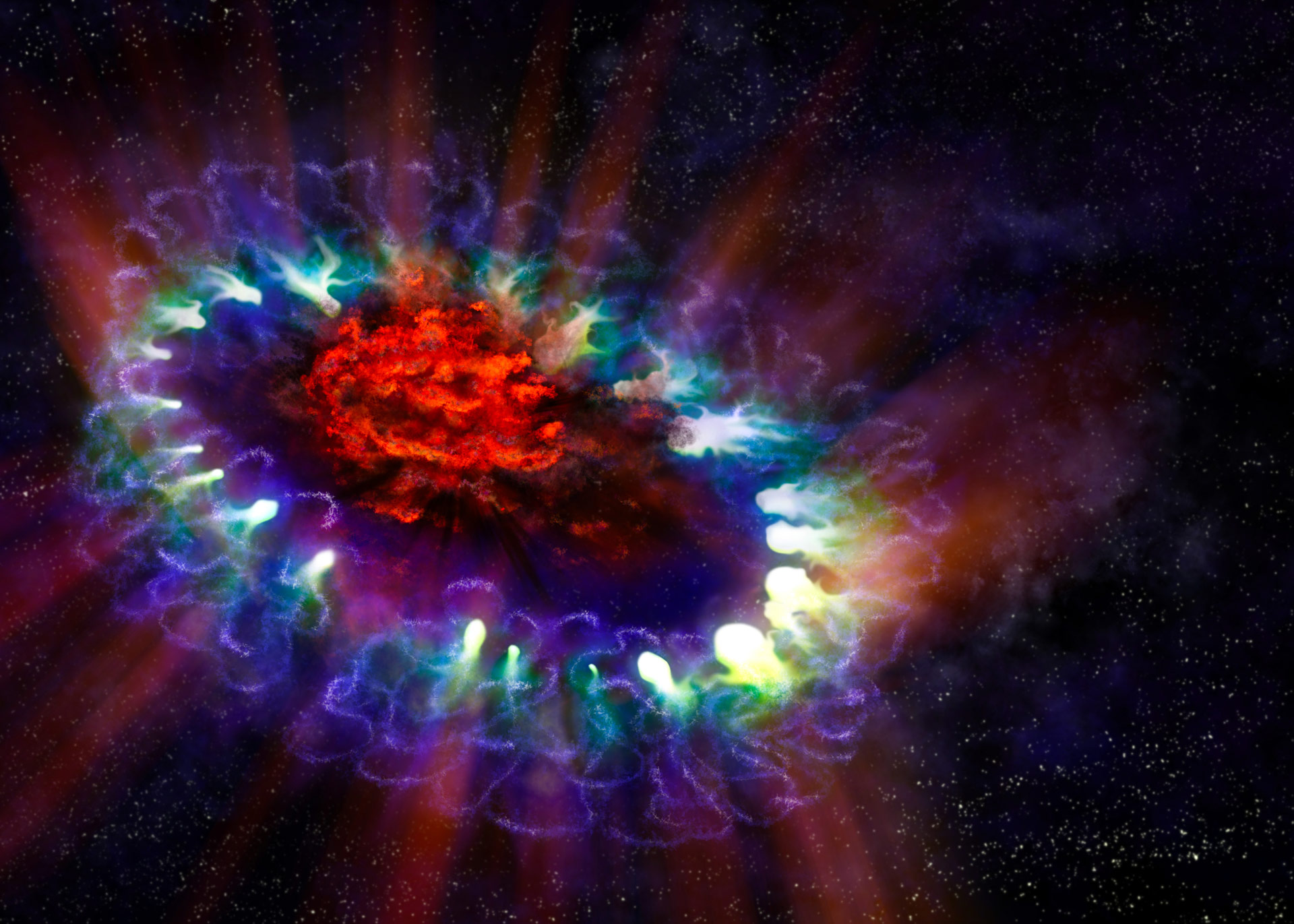
Forget fireworks, these things produce more colors than the colors found in a one hundred and twenty crayons in a Crayola crayon box. These supernovas can come in many shapes and sizes but when a cool explosion happens, it is a circular shape.
So what exactly is a supernova and how is it formed? A supernova is a stellar explosion that briefly outshines an entire galaxy, radiating as much energy as the Sun or any ordinary star is expected to emit over its entire life span, before fading from view over several weeks or months. Because our knowledge of space is so limited, scientists and physicists don't exactly know how supernovas are formed, however, a theory called the "Supernova Nuleosynthesis" theory is currently being used to broaden our understanding.
This theory, proposed by Fred Hoyle in nineteen fifty-four, states that with the fusion of lighter elements, such as hydrogen, helium and carbon, with the fusion of heavier elements such as titanium, iron and chromium, and the burning of oxygen and silicone, can create these beautiful explosions.
This theory also highlights a couple of things:
1) Every time an explosion occurs, we can observe all of the elements present. For example, when sulfur burns, it produces a blue color. Hydrogen produces an orange color when burning and mercury, depending on its chemical formula, will burn black for HgO and red for HgO 2+. By knowing the colors of each element present, we can accurately determine the amount of each element present in that certain area of the universe.

2) By following this theory, enough type of each metal and gas needs to be present in order to create planets such as Earth and Mars. This process can take a couple million to over a billion years to make happen in the fact that massive objects in space are formed from the deaths of generations of stars which then collect a decently sizable cloud to create an even bigger stars, which then forms into a "rock." This process continues to repeat itself endlessly.
So what do supernovas have to do with the news today? Astronauts, scientists and physicists are always on the lookout for supernovas, but they cannot accurately predict the timing and place of a supernova, thus, most of the time, they miss it. This past week, scientists and astronomers from NASA were able to pinpoint a supernova occurrence, due to the positions of the two stars, and are patiently waiting to record every single detail and they will be one step closer to solving the origins of the universe.
Thursday, February 5, 2015
The SMARTest App for a SMARTphone
Iphones and any type of smartphones are known for its unlimited wealth of myriad knowledge. It can tell you the weather, keep track of what you eat, give you ratings of the near gas prices, and can keep you entertained for several hours on end. What is interesting about smartphones is the eclectic amount of apps it has, and day by day the numbers keep increasing, however, by remodeling an accessory to it, a smartphone can be turned into a gadget that can detect HIV and syphilis in just fifteen minutes!
This is the remodeled device

Developed by a research team from Columbia University, this device can effectively track if one has HIV or syphilis with the indication of specific biological markers derived from a single drop of blood. It performs a triplexed immunoassay not currently available in a single test format: HIV antibody, treponemal-specific antibody for syphilis, and non-treponemal antibody for active syphilis infection. Compared to the original test called the ELISA (enzyme-linked immunosorbent assay), this new ELISA test performs the same functions but at a significantly lower price. The equipment needed for the original ELISA test can cost over twenty thousand dollars, but the makeshift test can cost just thirty four dollars.
The amazing thing about this test is that it is powered by the smartphone. There is no stored energy being used and it requires minimal power to operate. When first starting the creation of this test, lots of power was needed to operate the ELISA. The first job of the engineers was to elimination the power-consuming source which was a vacuum of some sort. The goal of this test is to make it cheap and affordable to many people as possible. At first, this test was aimed to reduce the current price of the ELISA to something that Americans can afford, but after seeing that reducing the power proved to be successful to projected predictions, the test then aimed to be affordable enough to help people in third-world countries, specifically countries in Africa such as Rwanda, where there has been an ongoing battle with HIV for centuries.
The test trials were first tried on by ninety-six patients and when it was proved to be successful, the next trials were then planned for one-hundred patients in Rwanda. The goal of this test is to prevent HIV transfer from mother-to-child by means of early diagnosis and with the affordability of this test, this idea may become reality for many people in third world countries.
This test is small,portable, easy to use, cheap and can produce results fast. Why wouldn't anyone want such a handy and useful tool? It's better than any app a phone has to offer and I think that it is a great investment for anyone in the near future.
This is the remodeled device
Developed by a research team from Columbia University, this device can effectively track if one has HIV or syphilis with the indication of specific biological markers derived from a single drop of blood. It performs a triplexed immunoassay not currently available in a single test format: HIV antibody, treponemal-specific antibody for syphilis, and non-treponemal antibody for active syphilis infection. Compared to the original test called the ELISA (enzyme-linked immunosorbent assay), this new ELISA test performs the same functions but at a significantly lower price. The equipment needed for the original ELISA test can cost over twenty thousand dollars, but the makeshift test can cost just thirty four dollars.
The amazing thing about this test is that it is powered by the smartphone. There is no stored energy being used and it requires minimal power to operate. When first starting the creation of this test, lots of power was needed to operate the ELISA. The first job of the engineers was to elimination the power-consuming source which was a vacuum of some sort. The goal of this test is to make it cheap and affordable to many people as possible. At first, this test was aimed to reduce the current price of the ELISA to something that Americans can afford, but after seeing that reducing the power proved to be successful to projected predictions, the test then aimed to be affordable enough to help people in third-world countries, specifically countries in Africa such as Rwanda, where there has been an ongoing battle with HIV for centuries.
The test trials were first tried on by ninety-six patients and when it was proved to be successful, the next trials were then planned for one-hundred patients in Rwanda. The goal of this test is to prevent HIV transfer from mother-to-child by means of early diagnosis and with the affordability of this test, this idea may become reality for many people in third world countries.
This test is small,portable, easy to use, cheap and can produce results fast. Why wouldn't anyone want such a handy and useful tool? It's better than any app a phone has to offer and I think that it is a great investment for anyone in the near future.
Subscribe to:
Posts (Atom)